Friday, July 27, 2012

A Tale of Two Markets: Part II, Newton County, Arkansas


 In my prior post about the farmers markets in Telluride and Mountain Village, Colorado, I promised to compare and contrast those markets with the one in Jasper, Arkansas, my home town.  Both places are similar in some ways, dramatically different in others.  First, both are rural/nonmetropolitan by most ecological measures, e.g., population density and size.  Indeed, both have similar total populations-- San Miguel County just over 7000, and Newton County just over 8000.  Both are also mountain towns (San Juans of the Rockies on one hand, Ozarks on the other), which benefit from ecotourism.  In fact, both are amenity rich in terms of outdoor activities, but Telluride has many more "built" amenities, and is quite cosmopolitan culturally.  This distinction and the crowd each county attracts is reflected in the annual accommodation and food service sales for 2007:  $77 million in San Miguel County, $3.2 million in Newton County.  That and the relative affluence are also reflected in retail sales per capita in 2007:  $13,114 in San Miguel County, $1,596 in Newton County.

The Newton County market is held on the courthouse square.
Tensions between old timers and newcomers are evident in both places.  In Telluride, those tensions often play out in planning battles, but presumably also in other ways.  Newton County does not engage in any planning or regulate building in any way, so these tensions are manifest in other ways.  In fact, my sense is that these conflicts have seemingly dissipated over the years, perhaps because long-time residents have come to see newcomers as a net gain to the community.

Beyond these similarities, the differences between the two places are more apparent.  Telluride is an extraordinary example of rural gentrification and is so obviously affluent, Newton County is a persistent poverty county, which means it is characterized by entrenched, inter-generational poverty.  I provided some socioeconomic data about Telluride and San Miguel County in my last post.  Here's some about Newton County:  Its poverty rate is 22.5%, and it's median household income is $27,441.  Whereas nearly half of San Miguel County residents have a bachelor's degree or greater, only 12.2% of Newton County residents do.  Newton County is a Federal/State Government dependent economy, while San Miguel County has a Service-dependent economy.

How is this very different demographic profile reflected in the two places' farmers markets?  I already provided lots of information about the Telluride and Mountain Village markets, and at least the former is fairly long standing.  The Newton County farmers' market, in contrast, started only this year, with a push from the Newton County Agricultural Extension Office.  (I don't even recall much of a tradition of farm stands in Newton County--just neighbors sharing the fruits of their gardens with others).  Whereas the San Miguel County markets take place weekly, spring through fall, the Newton County market takes place only on one Friday evening a month, from 4 pm to 6 pm (aiming to catch people passing the courthouse square on their way home from work), with the last market of the season likely to be this week (though in future years it might be in August, absent present doubt conditions).  I don't know the cost of participating in the Telluride market, but participation in the Newton County market costs just $5/week, and the Extension Office is considering the option of an annual fee.  I'm not sure what participants get for that -- presumably the benefit of a sign announcing the market, which I saw in a newspaper story about it.


While vendors at the Colorado markets were numerous, only five vendors showed up to participate in the Newton County market on the Friday in early July when my mom showed up to take these photos as my proxy.  She found four fruit and veg vendors and one craftsman.  One of the food vendors had not only fresh produce, but also home-baked goods and jams and relishes for $5 each.  That's less than half the $11/jar cost at Mountain Village.  Tomatoes were $6/lb in Colorado, but only $2.25 in Newton County (and my mom declared them the best she's ever eaten).  The selection wasn't extensive -- certainly none of the kohlrabi featured at the Mountain Village market--but it included some potatoes, peppers, and squash in addition to the items noted above.  I suspect most vendors simply brought excess bounty from their own gardens, and that they did not decide what to plant because of the existence of the market.  I don't believe any of the vendors are engaged in agritourism, but I suspect those selling jams and relishes don't also market those at the nearby gift shops on Scenic Highway 7 (see the figures below).  No one at this market is making a living off the market, which is quite different to what I learned about the Colorado markets.

All of the vendors at the Newton County market were from within the county, population 8,264.  I suppose it is not a sufficiently attractive market in terms of income potential to draw vendors from a wider area.  And I suspect most if not all vendors brought excess bounty from their own gardens, that they had not decided what to plant because of the existence of the market.  I don't believe any of the vendors are engaged in agritourism, but I'd be surprised if those selling jams and relishes don't also market those at the nearby gift shops on Scenic Highway 7.  Unlike in Telluride, none of the vendors had signs or brochures indicating their names or that of their farm; certainly, these Newton County farmers had not invested as much as the Telluride vendors in display aesthetics.

I recently came across U.S. Government data on some of the very questions I was addressing.  Here's the county-to-county comparison on a range of agricultural data points, from the Atlas of Rural and Small-Town America:
  • Principal Operator 10 years or more on same parcel:  San Miguel County, 87; Newton County,  439
  • Principal Operator 2 years or less on same parcel:  San Miguel County, 1; Newton County, 35. 
  • Number of farms:  San Miguel County, 123; Newton County, 636.
  • Percentage of land being farmed:  San Miguel County, 18.3%; Newton County, 21.5%.
  • Average market value of product sold:  San Miguel County, $27,235; Newton County $29,907.
  • Percentage of farms with sales below $10K in 2007:  San Miguel County, 71%; Newton County,  68%.     
  • Average government payment 2007:  San Miguel County, $9230; Newton County, $1756.
  •  Percentage of farms with income from agritourism:    San Miguel County, 4.87%; Newton County, 0.47%.  
  • Percentage of farms engaged in value-added production: San Miguel County, 8.9%; Newton County, 5.3%.
  • Percentage of farms using CSA:  San Miguel County, 1.62%; Newton County, 0.
  • Percentage of farms with high speed internet:  San Miguel County, 48%; Newton County, 24%.
  • Percentage of operators working off farm:  San Miguel County, 38%; Newton County, 46%. 
  • Percentage of farms with woman operator:  San Miguel County, 18%; Newton County, 14%. 
I acknowledge that this county-to-county comparison is a bit misleading about the markets because, as acknowledged in my earlier post, food at the Telluride area markets actually comes from many neighboring counties, not only from San Miguel County.  Nevertheless, I find it an interesting comparison. 
Note the small market, and the wooden chairs for sale by one vendor. 
Cross-posted to Legal Ruralism

Labels: , , , , , ,

Monday, July 16, 2012

A Tale of Two Markets: Part I, Telluride, Colorado

As some of my recent posts (here and here) suggest, I've been thinking for some time about the booming farmers' market phenomenon in relation to the slow/local food movement and, in particular, how local--and affordable--the food at farmers' markets really is.

Stall of hole foods farm, La Sal, Utah, at Market on the Plaza
As a ruralist, I'm also interested in what the farmers' market phenomenon says about our connection to rural places and the extent to which rural economies benefit from it.

This week I had the opportunity to visit two markets in southwest Colorado, one in the posh town of Telluride and the other in the equally posh (but more obviously nouveau riche and glitzy and less old West cowboyish) neighboring town of Mountain Village.  In a two post-series, I am going to compare these markets with a newly established one in my hometown, Jasper, Arkansas.  This first post will be dedicated to the Colorado markets. 
High Wire Ranch booth, TFM, July 13, 2012.

Before I get down to what I saw at the markets, let me provide some background on Telluride, which I have written about previously here and here.  As these prior posts indicate, I see Telluride as a prime example of rural gentrification.  With a population of 2,221, Telluride is the county seat of tiny San Miguel County, which has a population of 7,490, a very low poverty rate of 9.8%, and a median household income of $66,399.  (To put this in perspective, the median household income for all of Colorado is $56,456, and for the nation it is $51,914).  Another demographic feature that really stands out is that nearly half of the county's residents have college degrees, whereas the national average is only about 30%. Many of the homes in Telluride and Mountain Village are second homes, occupied only part of the year.  Telluride in particular is a rigorously slow/no growth community, and nimbyism is rabid there.  On both days last week when I read the local paper, it featured front-page stories covering San Miguel County Planning Commission news. 

It is not surprising given the demographic profile of TellurideMountain Village, and the surrounding county that the offerings at these markets were, well, upmarket.  Lots of organic produce and grass fed beef, lamb, elk, and bison were for sale.  Both weekly markets--Wednesday afternoons in Mountain Village and Fridays in Telluride--also featured pottery, jewelry and other such artisinal wares from places as far away as Durango.  Prepared food was for sale, too, and at the Mountain Village market, you could even get a massage.  In fact, the Mountain Village market is called "Market on the Plaza" rather than farmers' market, and it offered far less food than other stuff.  Perhaps 4-5 stalls/tables out of 15 or so featured fresh fruit and veg, beautiful flowers, and one offering grass-fed beef.   The Telluride Farmers' Market (TFM) was much larger, with perhaps half of the several dozen stalls featuring farm produce.  Plus, as many of the food vendors were offering meat as were offering fruits and veg--something I don't see so much in California.  This meant that most of the meat vendors had brought entire display freezers, plugged in to central electricity outlets.  One stall had its organic whole chickens on ice.   
Canyon of the Ancients near Cortez offered
wild apricots and grass-fed beef. 

As for the provenance of the food, the TFM website indicates that it all comes from within a 100-mile radius, and the same is probably true of the Mountain Village Market.  At the latter, I chatted with one vendor, hole foods farm (highly recommend the sugar snap peas at $4/pound!), out of La Sal, Utah.  As the crow flies, that is certainly within a hundred miles, though it's no short journey through the mountains into Telluride's box canyon.  The same is true for the vendors from Cortez (population 8,482), Paonia (population 1,497), Hotchkiss (population 968), Norwood (population 438), and Colona (population 30).    

James Ranch, a farm stall, "Harvest Grill & Greens," guest ranch, and all around agritourism operator was at TFR promoting their operation, which is north of Durango.

Parker Pastures of Gunnison was at the Telluride market offering eggshares, CSA, and sales of meadow-fed bulk meat.  Parker also offers herdshares for purposes of providing raw milk because simply selling the milk is illegal in Colorado, as it is in California.  The brochure they provide indicates that if you buy in, "we will present you with two legal documents, the Bill of Sale and Boarding Contract."  The cost for a half gallon of raw milk each week is $35 for the share and $5.50/week to cover the cost of feeding, housing and milking the cows.  The milk can be picked up on certain days in either Crested Butte or Gunnison.  Their motto is "Nourishing our Community.  Nourishing our Lands."
Mesa Mix is offered by TomTen Farms, Placerville
I talked to several of the meat vendors.  One told me that he and his wife make a living from what they sell at the Telluride market on Fridays and the Aspen market on Saturdays.  Their farm is about half way between the two. Of course, they also acquire customers at these markets, customers who then place mail orders.  A lamb vendor told me she was there for her daughter, a recent college graduate who raises the lambs (and began doing so as a 4-H'er) but whose day job as a supervisor at a meat packing plant in Durango prevents her from being at the market herself.  The 20-something lamb rancher wasn't the only youngster represented at the market.  I also talked to three young farmers from Buckhorn Gardens, Colona, whose motto is "feed the soil, feed the body."  Their blog features photos and bios of their "New Agrarians," who come from around the country to work on the farm.   Other farmers and ranchers I met were a bit longer in the tooth, but one of the things I really enjoyed was actually meeting some farmer/entrepreneurs, not just their marketeers.  

It was hard for me to assess the price points on the meat offered at the markets since I rarely buy meat.  The brochure I took away from High Wire Ranch, however, put the price of a pound of ground elk or ground bison at $9, while elk tenderloin is $50/lb, bison tenderloin is $40/lb, and elk skirt or flank just $10/lb.  Sausage ranged from $10-$12/lb.  These folks also sell duck eggs for $6/half dozen and they feature Wild Alaskan halibut and salmon--presumably caught and packaged by someone other than themselves.  It all looked tempting, even for someone like me who doesn't eat red meat and who had no place to cook it.
Stall of hole food farms, La Sal, Utah, at Market on the Plaza
The fruits and veggies were perhaps more expensive than what you find in local grocery stores in the area--which are already quite pricey because of the place's remoteness and size and demographic of the population.  One stall at the Mountain Village market featured tomatoes at the especially dear price of $6/lb, and the going price for cherries and apricots was $6/bag.  Japanese cucumbers were $2/each and Sweet Walla Walla onions, $3/lb.  Greens tended to go for about $5/bag, and prepared sauces for more than $10 a pint.  Still, these upscale Colorado produce markets were only marginally more expensive on most items than what I find at farmers' markets in greater Sacramento--except on items like tomatoes, which are quite a bit less expensive down here in "Sacatomato" land.     

The TFM website enumerates the following goals for its market, which it calls a "living, evolving event that actively and tangibly enhances the quality of life in Telluride":
  • Fresh, local foods for residents and visitors
  • Supports organic agriculture and environmental issues
  • Improves community spirit
  • Additional attractions for tourists
  • Improve/maintain bioregional biodiversity
  • Reduced environmental impacts with shorter transportation of local foods
  • Increases rural/urban links
  • Invigorates secondary shopping areas
  • Educational--awareness of farming, sustainability, etc.  
Stand of Buckhorn Gardens, Colona, at TFM
As this tiny sampling of photos indicate, both markets offered very salubrious experiences--come rain (Telluride on Friday) or shine (Mountain Village on Wednesday).

In my next post, I'll compare these markets to a new one in Newton County, Arkansas, a persistent poverty county in northwest Arkansas whose agricultural history runs primarily to subsistence farming. Cross-posted to Legal Ruralism.
Market on the Plaza, July 11, 2012

Labels: , , , , ,

Thursday, July 12, 2012

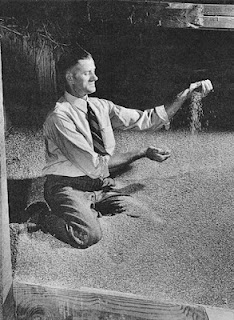
The farmer and the commerce clause

Roscoe Filburn

The landmark case of Wickard v. Filburn, 317 U.S. 111 (1942), has been the subject of extensive discussion on Agricultural Law. Filburn has now drawn the attention of National Public Radio. I was interviewed in connection with a July 5, 2012, NPR broadcast that featured Filburn and its role in the Supreme Court's health care reform decision. I invite you to download the podcast of that interview. Better yet, simply enjoy the show right here:

Monday, July 09, 2012

Global and Environmentally Sensitive “Food Justice”

(The following is cross-posted from the Ratio Juris blog. I'm grateful to Professor Jim Chen for inviting me to post it at this wonderful blog, which has many more readers than Ratio Juris!)

At Crooked Timber this morning, John Quiggin draws our attention to a debate about producing and consuming “local food,” a debate in part driven by an ecological concern with “food miles.” One side of this debate is captured in the abstract from the article by Pierre Desrochers and Hiroku Shimizu (here associated with the Mercatus Center at George Mason University):

“As modern food production and distribution becomes ever more complex and globalized, a ‘buy local’ food movement has arisen. This movement argues that locally produced food is not only fresher and better tasting, but it is also better for the environment: Because locally produced food does not travel far to reach your table, the production and transport of the food expend less energy overall. The local food movement has even coined a term, ‘food miles,’ to denote the distance food has traveled from production to consumption and uses the food miles concept as a major way to determine the environmental impact of a food.

This Policy Primer examines the origins and validity of the food miles concept. The evidence presented suggests that food miles are, at best, a marketing fad that frequently and severely distorts the environmental impacts of agricultural production. At worst, food miles constitute a dangerous distraction from the very real and serious issues that affect energy consumption and the environmental impact of modern food production and the affordability of food.

The course of the debate over food miles is nonetheless instructive for policy makers. It highlights the need to remain focused on the issues that are important—in this case, the greenhouse gas emissions of highly subsidized first-world agriculture, the trade imbalances that prevent both developed and developing countries from realizing the mutual benefits of freer trade, biofuel subsidies, and thirdworld poverty. With the population of the planet growing rapidly, numerous food policy issues other than food miles should preoccupy policy makers.”

Desrochers and Shimizu have expanded their argument into a book, The Locavore’s Dilemma: In Praise of the 10,000-Mile Food Diet (New York: PublicAffairs, 2012).
At AlterNet, Jill Richardson does not address their specific argument head-on, but prefers instead to attack the putative inability of neo-classical economic assumptions and models to properly address the relevant issues she believes are raised in any such debate. At Crooked Timber, Quiggin himself highlights some surprising ideological inconsistencies in the argument, at least insofar as we entertain certain expectations regarding the parameters of this debate, given the political and economic orientations of the respective parties. As for the debate itself, I think Desrochers and Shimizu have the better argument on the specifics, while Richardson appropriately raises several of the more important variables necessary for addressing health and justice issues generally with regard to the production and consumption of food, both here and abroad. In some respects, this is a perfect example of a debate in which the parties are, to a considerable extent, speaking around and past one another.

For my part, I put together the following list of titles I believe are useful—indeed, fundamental—for thinking about the subject matter of this discussion, which should be conducted within the framework of an environmentally* sensitive concern with global distributive justice:
  • Bardhan, Pranab, Samuel Bowles and Michael Wallerstein, eds. Globalization and Egalitarian Distributive Justice (Princeton, NJ: Princeton University Press/New York: Russell Sage Foundation, 2006)
  • Barry, Christian and Thomas W. Pogge, eds. Global Institutions and Responsibilities: Achieving Global Justice (Malden, MA: Blackwell, 2005)
  • Brock, Gillian. Global Justice: A Cosmopolitan Account (New York: Oxford University Press, 2009)
  • Clapp, Jennifer and Peter Dauvergne. Paths to a Green World: The Political Economy of the Global Environment (Cambridge, MA: MIT Press, 2005)
  • Dasgupta, Partha. Human Well-Being and the Natural Environment (New York: Oxford University Press, 2001)
  • Drèze, Jean and Amartya Sen. Hunger and Public Action (New York: Oxford University Press, 1989)
  • Drèze, Jean, Amartya Sen, and Athar Hussain, eds. The Political Economy of Hunger (New York: Oxford University Press, 1995)
  • Gottleib, Robert and Anupama Joshi. Food Justice (Cambridge, MA: MIT Press, 2010)
  • Jasanoff, Sheila and Marybeth Long Martello, eds. Earthly Politics: Local and Global Environmental Governance (Cambridge, MA: MIT Press, 2004)
  • Light, Andrew and Avner de-Shalit, eds. Moral and Political Reasoning in Environmental Practice (Cambridge, MA: MIT Press, 2003)
  • Miller, Richard W. Globalizing Justice: The Ethics of Poverty and Power (New York: Oxford University Press, 2010)
  • O’Brien, Mary. Making Better Environmental Decisions: An Alternative to Risk Assessment (Cambridge, MA: MIT Press, in association with the Environmental Research Association, 2000)
  • Patel, Raj. Stuffed and Starved: The Hidden Battle for the World Food System (Brooklyn, NY: Melville House, Melville House Publishing, 2007)
  • Sen, Amartya. Poverty and Famines: An Essay on Entitlement and Deprivation (New York: Oxford University Press, 1981)
* “Environmentally” rather than simply “ecologically” because the former term includes yet transcends what falls within the rubric of the sciences of ecology.

See too this post from April 2008 at Ratio Juris: “The Ecological and Political Economy of Hunger”

Sunday, July 08, 2012

Harvard Food Policy Career Guide

I am pleased to link to a very helpful resource developed through a partnership between the Harvard Food Law and Policy Clinic and the Harvard Food Law Society.

It is the Food Law & Policy Career Guide.

"If you are a law student, emerging young professional, interested food policy advocate, or someone simply searching to learn more about what food policy entails, these resources from across the nation (and world) to help you find your next job, volunteer position, or internship in the world of food policy."

Appreciation is expressed to Emily Broad Leib, the Senior Clinical Fellow in the Harvard Law School Center for Health Law and Policy Innovation and Director of the Center's Food Law and Policy Clinic for her work on this guide and for allowing us to post it.

Friday, July 06, 2012

Does urban farmers' virtue differentiate them from rural ones?


I know the association of urban ag/slow food/organic/locavore movement with all things virtuous has been going on for some time, but just because the movement has proved so self-congratulatory (and mostly bourgeois) didn't necessarily make rural farmers the "bad guys."  I figured that, more than anything, the slow/local/urban ag craze was, at worst, implying (if only to those too myopic to look beyond their own food needs) that large-scale farmers (and, by extension, rural communities and populations) were (becoming) obsolete.  

But a story in the New York Times a few days ago left me wondering if the urban ag trend (the fruits of which I admit to regularly indulging from my suburban home in greater Sacramento, where many posh farmers markets surround me) also makes rural farmers look less virtuous, even a bit like "the enemy."  Kirk Johnson's story focused on what he called a new business model of farming, one marked by smaller-scale farms on the outskirts of cities, producing food primarily for metropolitan areas, including their fine dining establishments.  Johnson asserts:
[T]he movement toward local food is creating a vibrant new economic laboratory for American agriculture.  The result, with its growing army of small-scale local farmers, is as much about dollars as dinner:  a reworking of old models about how food gets sold and farms get financed, and who gets dirt under their fingernails doing the work.  
* * * 
Economists and agriculture experts say the "slow money" movement ... a way of channeling money into small-scale and organic food operations, along with the aging of the farmer population and steep barriers for young farmers who cannot afford the land for traditional rural agriculture are only part of the new mix.  
OK.  That's an interesting business story.  I have written herehere and here of some of these phenomena, e.g, the obstacles facing new farmers and the aging farmer population in the United States.

But then Johnson goes on to suggest that this small farm/locavore phenomenon is not only in opposition to intensive production agriculture, but also in opposition to rural places, which he seems to collapse into "big ag." Johnson writes
A looming shortage of migrant workers ... could create a kind of rural-urban divide if it continues, with mass-production farms that depend on cheap labor losing some of their price advantages over local grown food, which tends to be more expensive.  
[While] big agriculture ... struggle[s] to find willing hands ...[l]ocal farm sales are becoming more stable, predictable and measurable.
Johnson goes on to note that the USDA has adjusted upward the value of "local revenues" from food sales to $4.8 billion.  The adjustment came from including sales to stores and restaurants and not only those at "road stands and markets."  (I wonder if that prior accounting included urban farmers markets.  I've written some about the distinction between road stands and farmers markets here).  Johnson notes that the economic pathway for these small scale farms that sell their food locally is somewhat supported in the new farm bill (which a NYTimes editorial recently labeled "mediocre")

Certainly, a lot of locavore/organic/slow and boutique food is grown in urban, suburban and exurban locales.  Read more here.  What Johnson overlooks--especially in writing of a "rural-urban divide"--is that these more "virtuous" types of food are also grown in rural places.  I (and my students) have written of instances of this herehere, and here.  Also illustrative is Low Gap, Arkansas, shown in these two photos I took in May, 2012.  Low Gap is a wide spot in the road in Newton County, where I grew up.  Low Gap is not even a Census Designated Place; nor does it have a wikipedia entry.  (As the sign indicates, it is near Shiloh, a similarly obscure place).  So I was surprised a few years ago to see it listed as the provenance of food on the menu at the Greenhouse Grille, 80 miles away in Fayetteville, where I doubt that even 1 in 100 diners had previously heard of Low Gap, let alone know where it is.  Surely this is not a lone example of a small, rural farm producing organic food for an urban population (yes, Fayetteville is urban, part of the Northwest Arkansas Metropolitan Statistical Area) and--if the sign above is any indication--for its rural neighbors, too.  Ditto Rivendell Gardens, also in Newton County, pictured in this post.  It is probably not appropriate, then, to suggest that urban/suburban farmers have cornered the market on either virtue or small.  

One thing seems certain:  If urban farmers are now sole (or even primary) bearers of the badge of agricultural virtue, we have come a long way not only from the rural yeoman farmer of Thomas Jefferson's day, but also from that of my grandparents (read more here) and a fair number of rural folk still operating smallish farms across America.

Yes, I know I am a little sensitive about this, but food and ag are two of the only justifications that rural people and places have for their existence these days.  If they lose the virtue associated with these--if only rhetorically--to "the city," they arguably lose a lot.   

Plus, I just think Johnson's invocation of the rural-urban binary in this way is misplaced.  Or maybe his use just reflects a common lack of precision in how the terms "rural" and "urban" get used.  Many of the farms Johnson refers to are far enough outside the cities they serve to be in places that are rural by several definitions, or at least exurban.  Alternatively, when Johnson talks about small farms and urban ag, he may actually be thinking less about where the food is grown and more about who is consuming it.  And that is as much a matter of class as it is geography.  

P.S.  On July 8, 2012, the NYTimes published this story on the front page of the Business section, "Has Organic Been Oversized?" which disputes the popularly held connection between small and organic.  It also disputes, in a sense, the authenticity of the designation.  Here's a key paragraph:
As corporate membership on the board [that sets standards for organic labeled products] has increased, so, too, has the number of nonorganic materials approved for organic foods on what is called the National List.  At first, the list was made up of things like baking soda, which is nonorganic but essential to making things like organic bread.  Today, more than 250 nonorganic substances are on the list, up from 22 in 2002.  
Cross posted to Legal Ruralism.  

Labels: , , , ,

Thursday, July 05, 2012

My Thoughts on EPA Fly-overs

In the last few weeks, there have been recurring, and sometimes wildly inaccurate news stories about the Environmental Protection Agency's "fly-overs." The bottom line is that the EPA sometimes uses planes to fly over large livestock operations such as feedlots to see whether there are violations of environmental laws, such as the improper discharge of animal waste into a waterway. The EPA also does periodic flyovers to check other businesses such as power plants. The aerial check is cheaper and is often the best way to see the full picture.

The Washington Post covered the story in its article, Midwest ranchers, congressmen protest EPA flyovers that look for livestock waste problems.

As noted in the Post article, some farmers and ranchers and their representatives in Congress have protested, and a bill was even proposed that would ban the flights over farms. Ranchers argue that it is intrusive, even "creepy" to have "big brother" watching.  I'd like to suggest otherwise.

Fly-overs provide the best view of agricultural operations. Pilots in small planes fly over farmsteads, take pictures, and then sell them to farm families on a pretty regular basis. We have purchased many of these pictures of our farm over the years. I love to see the changes from year to year.


Farmers, their advisors, and their consultants do flyovers all the time to check crop conditions. Ranchers use flyovers to check their cattle on the range. The picture to the left is our farm, as shown on google maps.

The USDA Farm Service Agency takes aerial photos of row crop farming operations regularly, as they have for years. A farmer can go into the local office and get the photos. They are used to certify acreage for farm program payments, and yes, they sometimes can be used to check compliance with conservation program requirements.

The EPA fly-overs are no big deal.

Aerial checks can and should be used to see whether businesses comply with the law. It is the cheapest, most efficient, and most effective way to assure compliance.

All the many, many farmers and ranchers that do the right thing and do their best to protect the environment should WANT the government to do these checks. When a business is able to violate the law and go undetected, all of the businesses that are in compliance suffer. The businesses that comply are forced to compete against the "cheaters" who short-circuit laws to lower their cost of production. When "cheaters" get caught, it levels the playing field for all businesses.

Finally, when farmers and ranchers again argue that people should not be able to see what they are doing, it only makes them look like they have something to hide.